

Every GOEX order starts with people, and last week, we gave our supporters a chance to meet them.
GOEX President Jessica Ray hosted a live Zoom call connecting our Kansas City warehouse with our factory floor in Port-au-Prince, Haiti. Ariane Manual, General Manager of GOEX Haiti, and Shelby Williams, Operations Director in Kansas City, walked supporters through what it actually looks like to make and move a GOEX order, cutting table to checkout.
Here’s a recap of what was shared.
A Team That Came Back
Ariane opened with something she wanted every supporter on the call to understand: the people sewing GOEX garments today are the same people who were doing it years ago.
The previous facility could no longer safely operate due to gang activity in the area, and GOEX Haiti employees went without work for nearly two years. When a new GOEX Haiti factory opened in Port-au-Prince last October, every single employee who had worked with GOEX before came back. Not some. All of them.
“Everyone here is a familiar face,” Ariane said. “That speaks to our values as a company, and it speaks to our family-like environment.”
Ariane described a leadership approach built on listening, she talks with employees regularly, no matter their role, because she believes people do their best work when they feel respected and understood. It’s a balance, she said, of empathy and accountability, and one she doesn’t often see modeled elsewhere in the industry.
Fair Wages, and What Comes With Them
Haiti recently introduced a significant increase to its minimum wage, along with a new production-bonus pay structure that hadn’t existed before. Ariane was candid that the change caused real confusion at first, both within GOEX and across the broader industry. It took time, and a lot of conversation, before employees felt confident in how the new structure worked.
GOEX didn’t stop at the new minimum. The team intentionally pays above it, maintaining a gap between GOEX wages and other factories in the region.
Beyond pay, GOEX Haiti employees receive a warm lunch every day, access to an open-door HR team, recently added eye exams, Christmas gifts, and a mid-year break, a full week off in addition to end-of-year time, specifically so families can spend time together.
Life Outside the Factory Walls
Ariane didn’t shy away from the harder realities, either. Much of Haiti, including areas near the factory, continues to be affected by gang activity. Employees are frequently displaced, moving in with extended family or relocating altogether, sometimes separated from loved ones who can’t make the same move. Some have recently been able to return home; others are still navigating an uncertain season.
“It’s not always what you see in the news,” Ariane said, “but when you hear the personal stories, it’s hard to hear.”
It’s part of why a steady job means so much more than a paycheck. Ariane shared a recent conversation with a local HIV clinic, where a doctor described how HIV cases in the community have dropped sharply, but anxiety and depression have become the most common reason patients now come in. The doctor’s own conclusion echoed something GOEX has said for years: one of the most effective ways to support people is to give them a job.
Faith, Family, and Strong Family
Faith plays a significant role in the lives of the GOEX Haiti team, and Ariane spoke to how deeply it’s held, even inside the workplace. It’s part of why GOEX has begun introducing Strong Family, a family-strengthening program that uses group learning to help families build skills and stability over time, to the Haiti team, starting small and growing intentionally. Participation is voluntary, and it sits alongside the other ways GOEX invests in employees’ lives beyond the factory floor.
Inside the Factory Floor
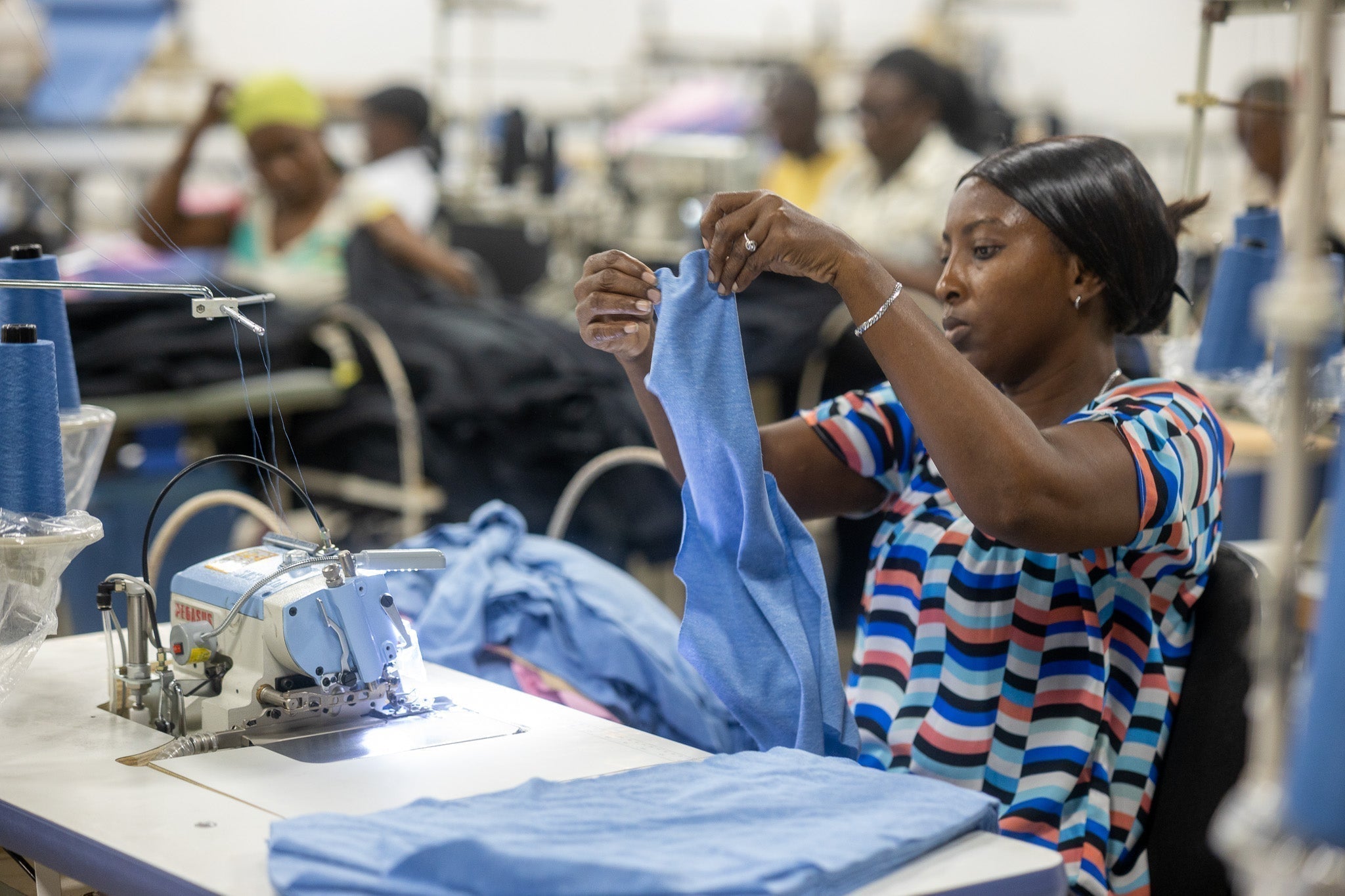
Ariane walked the call through the full production process: the cutting floor, where fabric is spread and cut to ratio; two sewing lines, one for specialty garments like fleece and hooded styles, and a faster-moving line dedicated to tees; and the trim, examine, and packing stations where every garment gets a final check before it ships.
On a consistent day, the tee line produces 1,100 to 1,300 shirts. The specialty line turns out around 450 garments, most commonly crewneck fleece. Altogether, that’s roughly 1,500 garments a day, produced by a team of 52.
The factory also follows the Better Work Haiti manual for manufacturing standards, covering everything from safety protocols to lighting to working conditions. Ariane noted that GOEX aims higher than the minimum, brighter, more comfortable spaces, because the team’s day-to-day experience in the building matters.
Meanwhile, in Kansas City
Back in the U.S., Shelby Williams gave supporters a live tour of the Kansas City warehouse, three automatic presses running, print jobs in progress for Feed My Starving Children and a 2,700-shirt order for Church of the Resurrection, and a container fresh off the boat from Haiti, delivering 12 pallets of restocked product.
It’s the other half of the same story: garments made with care in Haiti, printed and shipped with care in Kansas City, landing in the hands of the customers and supporters who chose to back this model in the first place.
One Team, Two Countries
Toward the end of the call, Fafa, who leads day-to-day HR at the Haiti factory, stepped in front of the camera with a message of his own: thank you, on behalf of the whole team, for investing in Haiti, even when the broader economic picture is difficult.
It’s a fitting note to end on. None of this, the jobs, the wages, the benefits, the stability, happens without supporters and customers choosing, order after order, to be part of it. Every GOEX purchase helps sustain fair-wage employment for 52 people, and for the families who depend on that work.
Thank you to Ariane, Shelby, Jessica, and the entire GOEX team in Haiti and Kansas City for opening things up and letting our supporters see it firsthand.


